

Yesterday, I wrote about the things we build as leaders that don’t last. I told the story of a successor who removed everything from my former office, including the desk, and of a spirit rock that students had dreamed up and that I helped make possible, only to see it removed after I left the institution.
My conclusion was that leaders don’t get to choose what lasts. I still believe that, but after writing the piece, I kept thinking about those two institutions. I realized there was another part of the story because, while some things disappeared, other things I helped create are still there.
At the institution where my successor removed the desk, there are two traditions that have now continued for about twenty years. One is a graduation tradition that students and I worked together to get started. I remember talking with those students about what they were creating and telling them that someday students they would never meet would participate in the same tradition. We believed we were creating something that could be passed from one generation of students to another.
It turns out we were right. If their children choose to go to that institution they will participate in a ceremony that their parents help to create.
At that same institution, I was also involved in writing a new Alma Mater. Twenty years later, students still sing it. Most of the students singing those words today weren’t even born when we created it, and they probably have no idea who was involved in writing it or how it came to be. They shouldn’t need to know. It isn’t ours anymore. It belongs to them.
When I think about that alongside the story of my old office, the contrast almost makes me laugh. The desk didn’t survive my departure, but the Alma Mater did. Someone apparently wanted no reminder of me in that office, yet twenty years later students are still singing a song I helped bring into existence.
Given the choice, I’ll take the song.
The same thing happened at the institution where the spirit rock was removed. The rock was something students had wanted, and I helped them make it happen. It became a meaningful campus tradition, particularly when new students began leaving their painted handprints on it during orientation. Eventually the rock disappeared, and I was disappointed when I learned that it was gone.
But something else we created there is still happening.
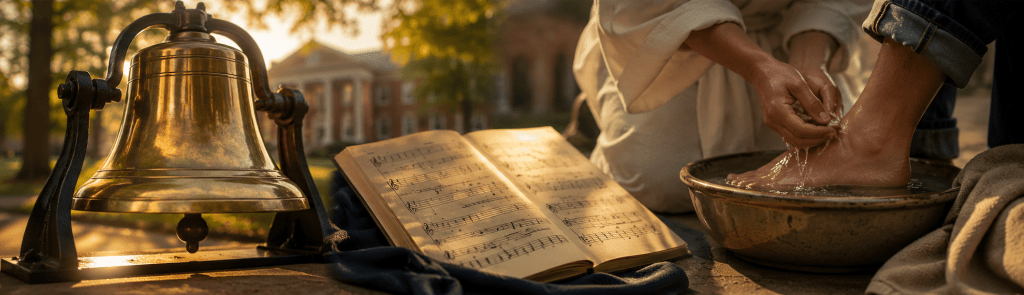
We developed a foot-washing ceremony for incoming freshmen, built around the idea of service and belonging. It was an intentional moment in which new students were welcomed into the community through an act that communicated something about the kind of institution we wanted to be. Years after I left, that ceremony continues.
The more I think about these examples, the more I realize that perhaps the lesson isn’t simply that some things last and some things don’t. As leaders, there are things we create because they solve today’s problem, and there are other things we create hoping they will become part of the story of a place. I knew the difference when we were creating those traditions. I hoped they would last, and in some cases I even told students that what they were beginning could continue for generations.
Twenty years later, it has.
There is something deeply satisfying about that, but not because I want anyone participating in those traditions today to know that I had anything to do with them. In fact, their not knowing may be evidence that the traditions truly succeeded. They have survived long enough to become disconnected from the people who helped start them. They no longer belong to us.
They belong to the institution.
That may be one of the differences between leaving a mark and building a tradition. A mark points backward toward the person who made it. A tradition keeps moving forward, passed from one group of people to the next until its origin becomes far less important than what it means to the people carrying it on.
I think there is a leadership lesson in that distinction. There are certainly things we build that need our attention, energy, and leadership while we are there. Some will disappear after we leave, and sometimes that will disappoint us. But there are also moments when we have the opportunity to help create something that becomes larger than any individual leader.
Often, those things don’t begin with the leader at all. A student brings an idea. A group sees an opportunity. Someone imagines a tradition that doesn’t exist yet. Leadership in those moments isn’t necessarily about having the idea. Sometimes it is about recognizing that an idea deserves a chance, helping remove the barriers, finding the resources, and then allowing other people to make it their own.
Perhaps that is why these traditions have lasted. They were never really about me.
Yesterday I wrote that we don’t get to choose what lasts, and we don’t. But perhaps we can be thoughtful about what we build with the hope that it will.
The things most worth leaving behind may not be the things that remind people we were there. They may be the things that continue bringing people together long after they have forgotten we ever were.


Leave a Reply