

For the past couple of days, I have been writing about some evergreen trees I planted outside Joy Hall about 26 years ago. I recently discovered that they are still there, towering alongside the building. There was something deeply satisfying about seeing that a small decision I made all those years ago was still having an impact on a place I left long ago.
But leadership doesn’t always work that way. Sometimes we leave an institution and the things we worked to create continue for decades. Other times they change, disappear, or are deliberately removed almost as soon as we are gone. I have experienced both.
At one institution, my successor apparently wanted a completely fresh start. After I left, he removed everything from the office, including the desk, and brought in a folding table to work from. I never completely understood the reason for it. I had enjoyed a strong relationship with the team I left behind, so it wasn’t as though he had inherited a department desperately trying to forget the previous administration.
For whatever reason, he wanted the space to become completely his. I will admit there was something strange about hearing that even the desk had to go, but it was his office now, not mine. I had left, and what happened in that space was no longer my decision.
Another experience was harder for me because it involved something that had never really been mine in the first place.
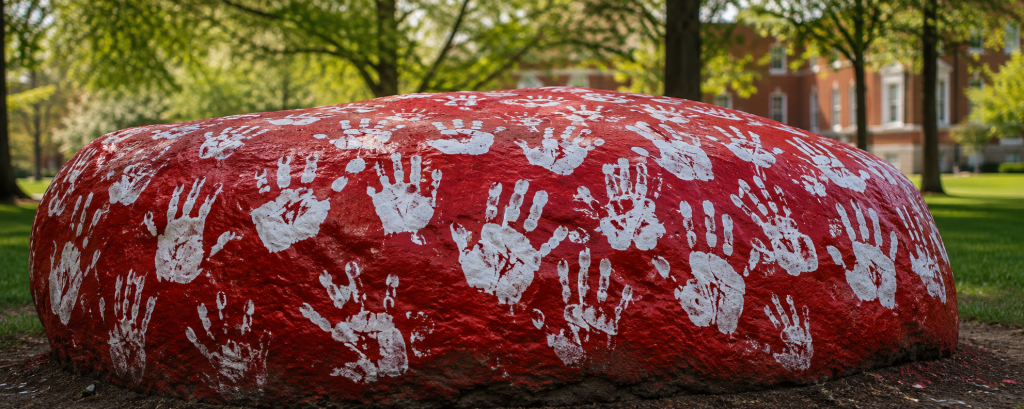
At another institution, some students came to me with an idea. They wanted a spirit rock on campus that students could paint. I loved the idea, and in my leadership role I was in a position to help them navigate the institution and make it happen. Eventually, a large rock was installed on campus and something wonderful happened: the students made it their own.
The rock became a place for expression, celebration, announcements, school spirit, and student voices. One of the traditions that developed around it happened during new student orientation. New students would put paint on their hands and leave their handprints on the rock. I loved what that represented. Before they had even taken their first class, they had literally left their mark on the institution. It was a simple way of telling students that they were now part of this place and that there was room for them to be seen and heard.
Of course, those handprints didn’t remain visible forever. Other students painted over them, and then someone painted over that paint. That was part of the point. The rock belonged to each new group of students, and every layer became part of what had come before it.
After I left the institution, the spirit rock was removed.
That disappointed me, but over time it has also given me something to think about. I had helped students turn their idea into reality, and then watched as they transformed it into something bigger than the original idea. I hoped the tradition would continue long after I was gone, but I no longer worked there and no longer had any say in what happened to it.
Those two experiences came back to me when I saw the photograph of the evergreen trees still growing outside Joy Hall. The contrast is hard to miss. The trees I planted are still there 26 years later. The desk from another office disappeared almost immediately. The spirit rock that students dreamed up, that I helped make possible, and that became part of the student experience eventually disappeared too.
Leadership literature talks a lot about legacy. We are encouraged to build sustainable programs, create healthy cultures, develop traditions, strengthen organizations, and leave places better than we found them. I believe in all of that, but there is an uncomfortable reality buried inside the idea of legacy: eventually we leave.
Once we do, we don’t get to control what happens next.
The people who follow us may treasure what we built. They may improve it or adapt it for a new generation. They may decide it no longer serves the organization. They may replace it with something completely different. Occasionally, they may even haul out the desk and replace it with a folding table.
That doesn’t necessarily tell us whether the original work was worthwhile.
The spirit rock no longer being there doesn’t erase what happened around it. Students really did bring forward an idea and see their institution respond. New students really did put paint on their hands and leave their mark. They really did have a place where their voices and creativity were visible on campus. Whatever happened to the physical rock later cannot go backward in time and take those experiences away from them.
I think that distinction is important for leaders. If we measure the value of our work only by whether it survives us, we may misunderstand what impact actually looks like. Some things are valuable because they last for generations, but other things are valuable because of what they do for people during a particular season.
There is humility in accepting both possibilities. We should build things carefully, develop other people, create opportunities, support good ideas, and try to make our institutions better. We should absolutely think about sustainability, but we also have to recognize that we are stewards rather than permanent owners of the places we lead.
The trees outside Joy Hall have taught me that something small can continue growing long after I leave. The spirit rock taught me something equally important: something doesn’t have to last forever to have been worth creating. Those students’ handprints may be gone, but for a time they told hundreds of students something I still believe every college student deserves to hear: you are here, you belong here, and you have left your mark.


Leave a Reply