

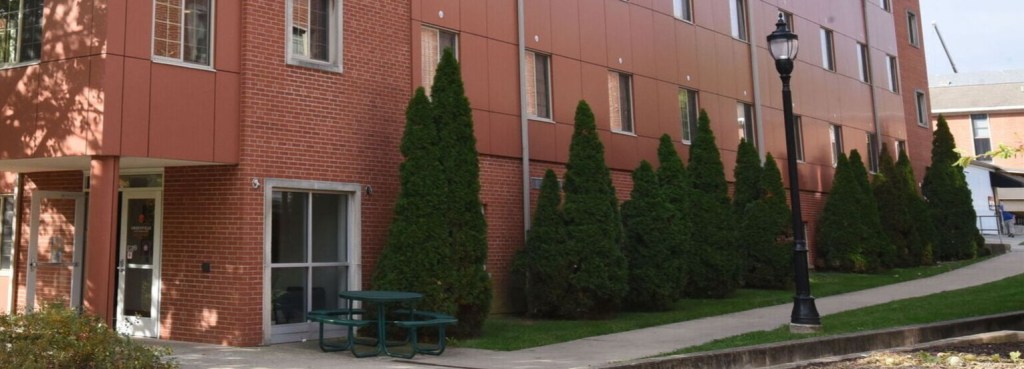
Yesterday, I wrote about the $2.50 evergreen trees I planted outside Joy Hall about 26 years ago. I wrote about discovering that they are still there and about how some of the small things we do as leaders can continue making a difference long after anyone remembers who did them. There is another part of that story I didn’t tell you: I didn’t ask permission to plant the trees.
I also didn’t set out one day determined to find trees for that space. I happened to be at Walmart when I saw small evergreens on clearance for $2.50 each. I immediately thought about that empty space between Joy Hall and Janssen Hall and realized the trees might be a solution. They could make the area look better and, as they grew, perhaps help absorb some of the sound that bounced back and forth between the two buildings.
So I bought them with my own money and planted them. I don’t remember even considering whether there was a process I was supposed to follow or someone I was supposed to ask. I was the Resident Director, this was the residence hall where my students lived, and I saw an inexpensive opportunity to make their environment better.
Facilities was not pleased, and they had a legitimate reason. Before I planted the trees, mowing that area was easy. They could drive the mower right along the edge of the building. Now I had put a row of obstacles in their way, which meant that every week someone was going to have to mow around those trees. My $2.50 solution had created additional work for someone else.
That led to an interesting conversation because, as it happened, I had something I wanted to talk with them about too. Since we were discussing lawn mowing around the residence halls, I asked if they could wait until after 8:00 in the morning to mow immediately next to the buildings. Their crews understandably liked to start early because it was cooler outside, but the buildings they were mowing around weren’t just buildings. People lived in them.
Some of our students’ beds were only a few feet from the outside walls. That meant a lawnmower could be operating at 6:00 in the morning just a few feet from the head of a sleeping student. From the perspective of the person maintaining the grounds, 6:00 a.m. made perfect sense. From the perspective of the student trying to sleep on the other side of the wall, it looked very different.
They had a point about my trees, and I had a point about their lawnmowers. Looking back with 26 more years of leadership experience, I think both parts of that conversation have something to teach me.
I don’t think the lesson is that leaders should simply do what they think is right and worry about permission later. My decision affected someone else’s work, and I hadn’t considered that before I started planting. Initiative is valuable, but our decisions rarely affect only us. What looks like a simple improvement from one part of an organization can create work, cost, or complications somewhere else.
At the same time, I don’t think the lesson is that we should become so cautious about processes and permission that we stop acting when we see opportunities to make something better. I didn’t go shopping for a solution that day. I saw $2.50 trees at Walmart and connected them to a problem I already knew existed. Sometimes leadership is simply being attentive enough to recognize an opportunity when it appears.
The disagreement also revealed something bigger than the trees. Facilities was looking at that strip of ground and seeing an area that needed to be maintained efficiently. I was looking at exactly the same space and seeing part of the home of the students I was responsible for. Neither perspective was unreasonable. We were standing in different places, so we were seeing different things.
I have encountered versions of that same tension many times since then. Someone proposes a change that would make things better for students, only to discover that it creates additional work somewhere else. Someone develops an efficient process that makes perfect sense operationally but doesn’t consider what the process feels like to the person experiencing it. Neither side necessarily has bad intentions or even has to be wrong. Sometimes they simply need to see what the other person can see.
Perhaps that is the part of this story that has stayed with me. Leadership requires initiative, but it also requires perspective. We need people willing to notice the $2.50 trees and imagine what they could become, but we also need someone to remind us that eventually somebody is going to have to mow around them.
Twenty-six years later, I’m still glad I planted those trees. If I could go back, though, I might have a conversation with Facilities before I started digging holes. Not because the trees shouldn’t have been planted, but because I’ve learned that making something better usually works best when we understand the people who will be affected by the change.
And perhaps that conversation would have accomplished something else as well. I could have learned a little more about what it took to care for the campus, and they could have learned a little more about what it was like to live there. We might even have planted the trees together, although I still would have asked that we wait until after 8:00 in the morning.
 Brandon D. Hill, PhD
Leave a comment