

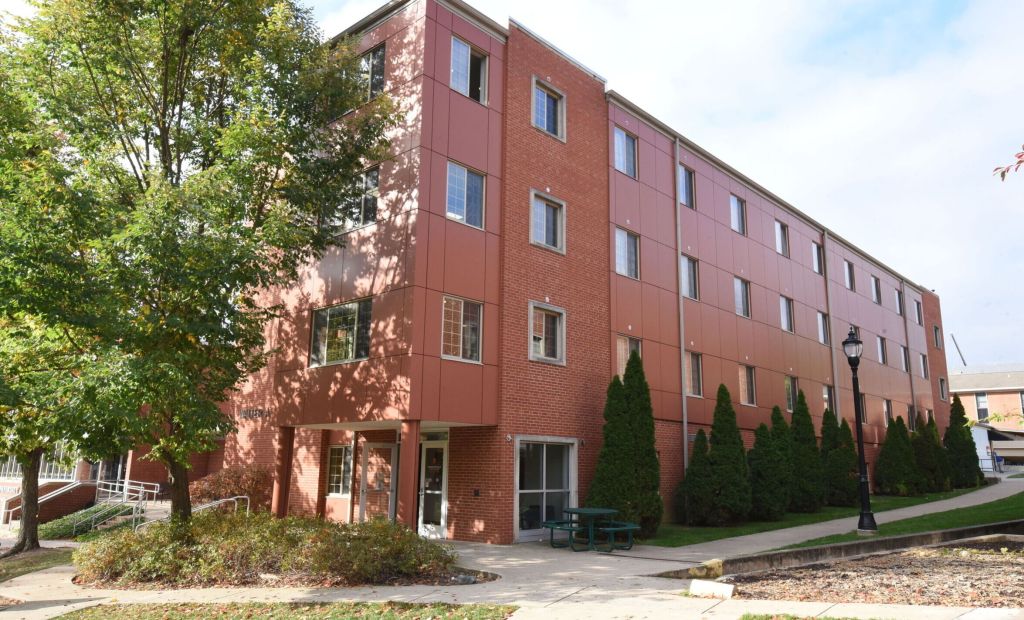
When creating the blog banner for yesterday’s post, I found a current photo of Joy Hall at Greenville University. I was looking at the building itself, trying to remember what it looked like when I was the Resident Director there in the late 1990s, when something along the side of the building caught my attention. The row of evergreens was still there.
I planted those trees about 26 years ago. I hadn’t thought about them in a very long time, and seeing them caught me by surprise. What I remember as little evergreen trees are now tall enough to reach several stories up the side of Joy Hall. They have simply been growing there all these years while I went on with my life hundreds of miles away.
When I was the Resident Director of Joy Hall, the space between Joy Hall and Janssen Hall wasn’t particularly attractive. It felt like an empty alleyway between two large buildings, and sound had a tendency to bounce back and forth between them. With residence halls full of college students, anything that might absorb a little sound seemed like a pretty good idea. I also simply thought the space would look better with some greenery.
So I went to Walmart and bought some evergreen trees. They were $2.50 each, and I paid for them myself. I planted them along the side of Joy Hall, hoping they would make the space look a little nicer and eventually help soften some of the sound between the buildings.
There was nothing particularly significant about the decision at the time. I wasn’t launching an initiative, developing a strategic plan, or trying to leave something behind that people would remember me for. I saw something that could be better, spent a few dollars, planted some trees, and went on to whatever problem needed solving next.
Twenty-six years later, the trees are still there, and they aren’t little anymore.
Looking at that photograph, I found myself thinking about all the students who have walked past those trees since I left Greenville. Thousands of students have probably lived in those buildings and walked through that space. They have hurried to class, stood outside talking with friends, moved into their rooms, moved out again, and experienced that little corner of campus with those trees simply being part of the landscape.
Almost none of them know who I am, and they certainly don’t know that I bought those trees at Walmart for $2.50 each. They don’t know that there was once a young Resident Director who looked at an unattractive, noisy space between two residence halls and thought it could be a little better. There is no reason they should know any of that, but they can still see and experience the result of a decision I made 26 years ago.
That realization has me thinking about leadership and the ways our influence can continue long after we have left a place. We tend to associate leadership with the things that are easiest to see: major initiatives, important decisions, organizational changes, new programs, titles, awards, and accomplishments we can put on a résumé. Those things can be important, but they aren’t the only ways leaders leave something behind.
Sometimes leadership looks like buying $2.50 trees at Walmart.
You notice something that could be better, and you do something about it. The solution may not be particularly exciting, and nobody may celebrate it. You may have no idea whether what you are doing will still be around next year, much less 26 years later. You simply have an opportunity to make something a little better than you found it, so you do.
There is also an important difference between making an impact and receiving credit for making an impact. Leadership can easily tempt us to connect the two. We want to know that something we did was successful, and naturally, we appreciate knowing that other people recognize our contribution. But some of the most enduring things we do may eventually become completely disconnected from our names.
Programs continue after the people who created them leave. Traditions become part of an organization’s culture even though nobody remembers who started them. Someone we encouraged years ago becomes a leader and passes that same encouragement along to someone else. A process we improved becomes simply the way things are done. An idea gets absorbed into an organization so completely that eventually nobody remembers there was a time before it existed.
And a row of $2.50 trees becomes a row of very big trees. The person who planted them disappears from the story, but what was planted continues to grow.
I think there is something wonderfully humbling about that kind of leadership. If we do our work well, some of what we create will outlast our involvement in it. Other people will take ownership of it, change it, improve it, or simply enjoy its benefits without ever knowing anything about the person who started it.
Those trees don’t need a plaque with my name on them. The students walking between Joy Hall and Janssen Hall don’t need to know who planted them. They are doing exactly what I hoped they would do 26 years ago. They make that space look better, they soften what was once an empty alleyway between two buildings, and I hope they still absorb a little of the noise bouncing around between the residence halls.
Seeing them again has made me wonder about the things I am planting today. As leaders, we make hundreds of small decisions that don’t feel particularly significant when we make them. We improve a process, encourage someone, solve an irritating problem, create an opportunity, change a practice, start a conversation, or invest in a person. We rarely get to see what all of those small actions eventually become.
Maybe that is what I will remember the next time something seems too small to make much difference. We don’t always know which decisions will take root, which investments will grow, or which things will still be standing 26 years from now. We just get the opportunity to leave the place in front of us a little better than we found it.


Leave a Reply