

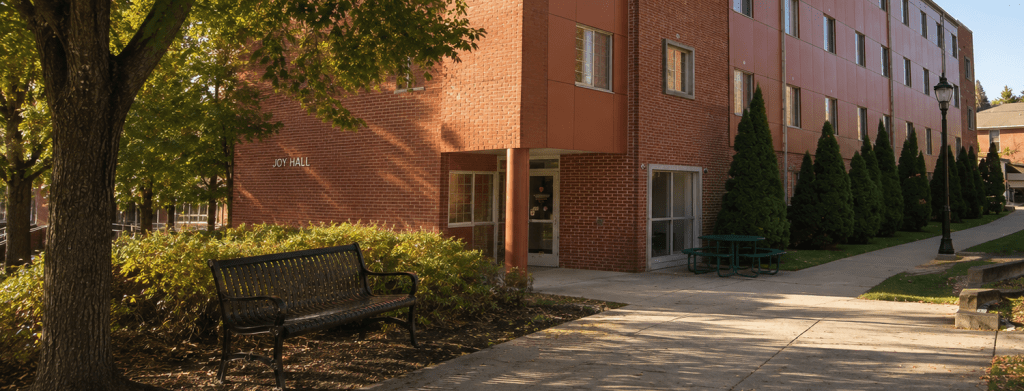
Many years ago, probably August of 1998 or 1999, I was sitting outside Joy Hall at Greenville College on the first day of school. It had been move-in weekend, which meant I was exhausted. I was the Resident Director of Joy Hall, and after helping welcome a building full of new students and their families, the freshmen had finally headed off to their first meeting.
The building didn’t have air conditioning, and it was one of those hot late-summer Illinois days when being anywhere inside seemed like a bad idea. So I went outside and found a shady spot under a tree. I was probably 27 or 28 years old. I had gauged ears at the time, with small rings in them, and I suppose I looked a little less like someone’s idea of a college administrator than I do today.
As I sat there recovering from move-in, the mother of one of my students walked over and sat down beside me. She asked how I was doing, and I told her I was tired but doing okay. Then she asked me a question I wasn’t expecting.
“Are your parents still here?”
It took me a second to realize what had happened. She thought I was a freshman. I was nearly ten years older than the students moving into the building, and I was the person responsible for many of them. But apparently, sitting under that tree with my earrings and my exhausted expression, I looked like another 18-year-old whose parents had just dropped him off at college.
I told her, truthfully, “No, they left a while ago.” I didn’t explain that it had been 10 years before. I still laugh when I remember the whole exchange.
I thought about that moment today because we are beginning another school year, this time at McLennan Community College. Almost three decades have passed since I sat under that tree outside Joy Hall, and I can say with considerable confidence that no parent dropping off a freshman this year is going to mistake me for their child’s classmate. Time has taken care of that particular problem.
The memory made me think about how strange leadership can be when you look at it across a lifetime. Back then, I had a leadership position. I had a title, responsibilities, students who depended on me, problems I was expected to solve, and decisions I was expected to make. By every reasonable definition, I was a leader, even if I apparently looked like I should have been asking someone where freshman orientation was being held.
What I didn’t have was any idea what nearly three more decades of leadership would teach me. I didn’t know how many people would pass through my life because of the work I had chosen. I didn’t know how many difficult conversations I would have, how many mistakes I would make, how many people would teach me something, or how often I would discover that what worked in one season of leadership wouldn’t necessarily work in the next.
There is something interesting about growing older in a profession. Early in our careers, we tend to notice the things we are gaining: responsibility, authority, experience, a better title, a larger office, perhaps a seat at a table where decisions are made. Eventually, though, the accumulation that seems most significant is something much less visible. We gain perspective.
With time, you begin to recognize situations you have seen before, although you also learn that no two situations are exactly alike. You become a little less impressed by titles and a little more impressed by people who quietly make things better. You discover that some decisions you thought were enormous were quickly forgotten, while small interactions you barely noticed became memories that someone carried for years. Perhaps most importantly, you become increasingly comfortable admitting how much you still don’t know.
Sometimes I wonder what I would tell that 27-year-old version of myself if I could sit down beside him on that bench. I’m not sure I would tell him very much. So many of the things I now understand about leadership couldn’t have been explained to me then; I needed the years and the people and the experiences to teach them to me. I think I would simply tell him to pay attention: to the students, to the people working beside him, to the moments that seem ordinary, and to the times when something doesn’t go the way he expected.
I would tell him that someday he would understand that leadership isn’t built primarily in the big moments when everyone is watching. Much of it is formed quietly over years through conversations, relationships, disappointments, decisions, mistakes, second chances, and ordinary days when you simply show up and try to help people move forward.
Somewhere between that first-day bench at Greenville College and another first day at McLennan Community College, leadership became much less about the position I held and much more about the person I was becoming. Maybe that is one of the gifts of getting older: you lose the ability to be mistaken for a freshman, but you gain the ability to see just how much you couldn’t see when you were one.
I do occasionally miss the days when someone could mistake me for a college student. But I wouldn’t trade what those years have taught me just to look 27 again. If someone can figure out a way for me to keep the perspective and experience while getting the 27-year-old metabolism back, however, I am absolutely willing to negotiate.
A note about the photo: The image accompanying this post was created with AI. Joy Hall has been remodeled since my days there, including a new addition to the front of the building. I searched through my old photos but couldn’t find one showing the building from this angle as I remember it. Using a current photo of Joy Hall as a reference, I used AI to recreate the setting, including the tree and the empty bench, as closely as I could to the place I remember from that day.


Leave a Reply