

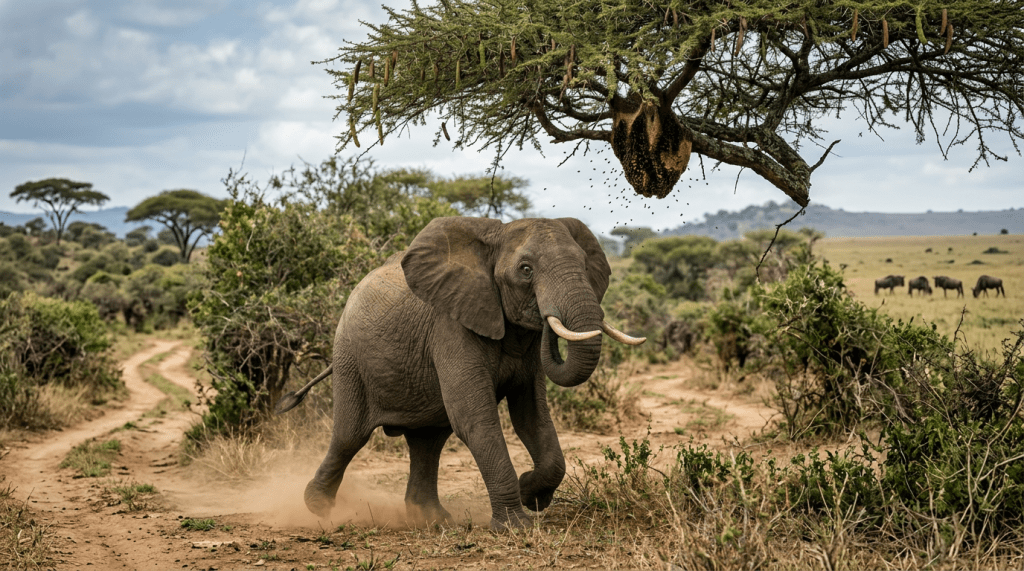
Indlovu is the Zulu word for elephant, a creature that throughout much of southern Africa symbolizes strength, memory, wisdom, and endurance. It feels like an appropriate place to begin this reflection because I grew up in Africa, where many of the stories and observations that shaped the way I understand life came not from classrooms, but from the rhythms of village life, conversations with elders, and the long tradition of African storytelling in which nature often becomes a mirror through which we better understand ourselves.
In several regions of Africa, farmers have long struggled with elephants wandering into gardens and crop fields. An elephant can destroy months of work in a single night. In communities where families depended directly on those crops for survival, the loss was not merely financial inconvenience. It could mean hunger, starvation, and even death for an entire village during difficult seasons. Traditional fencing often proved ineffective, and direct confrontation placed both people and elephants at risk.
This was not abstract to my family. My grandfather lived in Rhodesia, now called Zimbabwe, and part of his responsibility in that region was dealing with rogue animals that had become threats to nearby villages. Some elephants learned that village gardens provided easy food and would repeatedly raid them despite efforts to drive them away. My grandfather was often tasked with tracking and killing those elephants when they became too dangerous. He also dealt with predators and other animals that had begun targeting humans, including lions, leopards, and even hippos, which are far more dangerous than many people realize.
Growing up with those stories gave me an early understanding that life in many parts of Africa existed in constant negotiation with nature. These were not stories about domination over animals, but about survival, balance, and the difficult realities communities sometimes faced.
Researchers eventually discovered something surprising: elephants are deeply wary of bees. Despite their enormous size and strength, elephants avoid African honeybees because stings around the eyes, trunk, and ears are painful and memorable. Conservationists responded with an ingenious solution. They built perimeter systems using actual beehives connected by wire. When an elephant brushed against the wire, the hives would shake, the bees would emerge, and the elephants would retreat.
What fascinated researchers even more was the next discovery. In some cases, elephants reacted not only to the bees themselves, but simply to the sound of buzzing. The memory of past pain had become enough to alter behavior.
There is something profoundly human in that image.
Most of us carry our own versions of buzzing bees through life. A painful experience, a humiliation, a rejection, or a deep disappointment can create emotional associations that linger long after the original moment has passed. Over time, we begin organizing our lives around avoidance. We avoid certain conversations, risks, ambitions, relationships, or opportunities not necessarily because danger still exists, but because somewhere within us the memory remains active.
A single failure may convince someone they are not capable of leadership. A betrayal may quietly reshape the ability to trust. Public embarrassment may silence a voice for years. The original event may have lasted only moments, but its influence can extend across decades.
What makes this especially difficult is that these boundaries often become invisible over time, because we gradually stop recognizing them as reactions to old experiences and instead begin accepting them as permanent truths about ourselves, allowing the buzzing to fade quietly into the background of our lives until we no longer even think about questioning it. Yet as life continues to unfold, people change, circumstances evolve, and the emotional conclusions we formed during one season of life are not always accurate reflections of who we have become, meaning that while the original hurt may have been very real, the limitations we constructed around that pain may no longer be necessary.
That does not mean every fear should be ignored. Some experiences teach wisdom and caution that genuinely protect us. But it is worth asking how many areas of our lives are still being governed by echoes rather than realities.
Many people move through adulthood with tremendous strength and capability while still unconsciously avoiding spaces connected to old wounds. They remain professionally successful, relationally functional, and outwardly composed, yet quietly constrained by assumptions formed years earlier.
The image of the elephant is compelling precisely because it challenges our simplistic assumptions about strength, reminding us that even the most powerful beings can be profoundly shaped by memory and past experience, and that the true question is not whether we have been wounded, because every person carries some form of hurt, disappointment, or loss, but whether those wounds are still quietly defining the borders of our lives long after the original danger has passed.
Growth sometimes begins with the willingness to revisit a boundary we have long accepted without examination. To pause at the edge of an old fear and ask whether the threat still exists, or whether only the memory remains.
Perhaps maturity is not the absence of fear, but the ability to recognize when the buzzing no longer deserves authority over where we are willing to go.


Leave a Reply